Saturday, June 9, 2012

Chasing John's ancestral villages and streets in Yorkshire

Margaret & Claire - Facebook friends
When I mentioned on Facebook that I was going to Barnsley in Yorkshire to take some photos for John and see what records I could find, my friend Claire who lives near Leeds offered to drive me around for the day.

Claire and I met on Genes Reunited about 2008 when I was tracking down an English test cricketer, Alexander Stuart Kennedy, who is connected to both our families.  We are not related, but found each other's information interesting and later became friends on Facebook.  Both of us are sociable beings, you might say.  Claire also likes investigating her family history.

I am staying at the Premier Inn, and it appears to be built on the top of a cliff in Barnsley - a considerable drop from the ground floor on one side.  Nice place, very friendly and feel quite comfortable on my own.  The rooms are very similar to our three or four star motel rooms in Australia.  VERY different from my hotel room in London, which was old and poky.


We started by driving to Dodworth (pronounced "Doddeth") just two miles out of Barnsley - a village which is now a commuter suburb.  However Dodworth Green, where John's gg grandfather was born to Joshua and Mary Moakson in 1790 is still very much a small community and very pretty.

The cottages opposite are from the 1700s.

The church was built in 1844, which is well after the Moakson family lived there.


We had a great yarn to a resident who was working in his garden, and he told us which houses and other buildings were there in the 1700s and which were built later.

The Enclosures Act affected the villages around Dodworth in the late 1700s - earlier than other counties.  The land was owned by the Osborne family, the Dukes of Leeds. Common folk were excluded from using the land, some became tenant farmers, others became agricultural labourers on farms or day labourers.  Of course coal mining became a big industry in the early 19th century, as did the linen weaving factories.  The land is now mainly agricultural.

We then drove on through Silkstone which is a big village where John and I visited in 2008.  It contains the church - All Saints Silkstone with Stainborough where Isaac Moxon of Dodworth Green was baptised.

Hoylandswaine is just another couple of miles further towards Penistone - we had lunch there.

We found a very nice pub with good fish and chips (for me) and icecream - of course.

Hunshelf, where Sarah Middleton, later Moxon (John's gg grandmother) said she was born.  This is a very bleak farming community - not even a village.

Poor Sarah - she didn't marry well, since Isaac Moxon was everything from a "publican" - probably inflated job title - to a gentleman's servant (on Sarah's death certificate) and she ended up a "pauper - laundress" on the 1851 and 1861 census.

She lived in Wortley Street, Barnsley as a widow.  The street is still there, and looks as ugly as it probably always was.


St George's church, Barnsley, demolished 1993
Isaac had died in 1850 and she was left to look after two small boys, Joshua and John. He was buried at St George's church, Barnsley.  It is very close to Wortley Street, but there is now a major road in between.


Joshua became a stone mason and came to Australia in 1867, the same year his mother died.  But he had already made a career for himself in London prior to migrating with his young family.

Claire and I had afternoon tea back at the Premier Inn, and then it was time to say goodbye.

I felt as though I'd known her for a long time, although this was the first time we'd met in person.  It was so nice of her to drive me around - something that would have been impossible on my own - or even in a motor home - John and I had driven through Barnsley on our last trip, and found nowhere to park.

Claire had never been to Barnsley before, so she was unfamiliar with this part of Yorkshire, but she had a trusty satnav which came in very handy.

First of three volumes I purchased today.
After she said goodbye, just before 4pm, I wandered down to the main shopping centre in search of a bookshop with local history books.  When I asked if there was a Waterstone's bookshop in town, even the locals were derisive!  In Barnsley!  Good grief!  I ended up finally at the Barnsley Chronicle, quite the other side of town.  And found the office locked!  And not open Saturdays!

I rapped the door, since it was not supposed to close until 5pm, and some very gracious cleaners opened up, and with the help of phone conversations with the office manager, I managed to pay cash for five books, and even got a 25% discount!  I said they should ask for double their salaries.

So to eat, and then to bed to download and edit the photos, and write this blog.

Tomorrow morning I will check out early and spend time in the library's Local History Archive which opens at 9.30 am.  My train to Banbury is not till sometime after mid-day.


Friday, June 8, 2012

Coventry with Carole and the girls

Carole and Margaret - friends since 1972
On Wednesday morning I said goodbye to Ange and Paul (temporarily anyway) and set off for Coventry in Warwickshire.  It was a two hour journey by train, with no changes necessary.  The only weird thing was that we travelled backwards to Reading, and forward from then on.

Ange had seen me off at Southampton Central, and Carole met me at Coventry station.  I had not seen her since 2008 when John and I met Carole and her husband Mike in town and they had shown me Coventry Cathedral (the ruins which are now a war memorial) and we then had a great pub lunch.

Carole and her girls
This time, I stayed over with Carole and her family.  I'd asked to meet her daughters, and what a delight they are - Sharn, CarolAnn and April.  I also met Sharn's daughter Eve (10) who was on half term holidays, and two young husbands, Anthony and Dave.  The girls had dinner with us and were most friendly and interesting and interested in my doings.

Eve with her grandad Mike
I had met Carole when I first moved out of home to live in a boarding house at Strathfield.  Carole was my room-mate.  I shared because I was saving hard to go back to England for a working holiday.  Carole was in Australia for a working holiday and went back to England in 1972.  I then stayed with her family in Coventry in 1973 or 4, and Carole came down to London for a weekend. Those were the days.

Eve, who is as bright as a button, with Frank (Bruno) the boxer
Now of course, Carole is a grandmother.  Who'd have thought!

Poole, Highcliffe and Lymington

Joseph R. Rose's wedding 1901 - wish we knew who the other people  were.
It's now Thursday evening and I am two days behind with my blog!  I'm currently in Barnsley, in a hotel room which reminds me of one of our good motels, the first such room I've had since I left Sydney.  But this blog is still about Hampshire - and Dorset.

I first met Hannah Mack on Ancestry.com, and we've since become friends on Facebook, even though I am older than her parents.  She has a History MA, which explains why a young person is so interested in family history.  She is also a distant cousin, being a descendant of my favourite ancestor's 17th child!  I am the descendant of his 2nd child, who is 27 years older than hers.

St Michael's church where John Rose is said to have taken refuge.
Her parents live just near Poole, and they were very interested to receive a copy of my story about John Rose, and I was interested to see the photo they had of him.  They also had a very good family photo of their ancestor Joseph R. Rose who built up a stevedoring company in Southampton with 5000 employees.  It was lovely to meet them and to swap family folk-lore.  We shall prove it all one day.  They had heard that John Rose had been a gambler, and used to take refuge in the church (probably St Michael's in Southampton) whilst trying to organise a settlement of his debts.  Sounds like something he'd do.

Ange and Paul had driven me down to their village just outside Poole, so after a delightful visit with Hannah's family, we set off to have lunch at Highcliffe, which is on the south coast outside Bournemouth.  It was very wet, quite a miserable day for driving really.  But we had a delightful lunch, apart from Paul getting exceedingly wet when he found the accessible entrance to the restaurant locked.  He nearly ran over the waitress who opened the door - she did not realise she was in his way.

Lymington Harbour
The Ship Inn


Ange drove us back via Lymington, which is in the New Forest not far from Totten where they live.  It is a delightful town, famous for its sailing community.  Here are some views of the harbour and the cobbled streets.


The cobbles were no good for wheelchair users.  There was no one else around since the shops had just shut and it was very miserable with the rain.  A delightful small town though.

Wednesday, June 6, 2012

Exploring Southampton Old Town

Yesterday (Monday) the rain held off ALL DAY, which was lucky since we planned to explore the Old Town of Southampton, mostly but not all of it inside the ancient walls, which still stand in many places.

Southampton was badly bombed during World War II, particularly in 1940.  My Tucker great grand-father owned a musical instrument dealership in Upper Canal Walk, and although he had died in 1924 (predeceased by my grandfather in 1919), his much younger second wife was still running it when the war broke out.  It was completely destroyed in 1940, together with all the other shops in Canal Walk.

Additionally, most of East Street, a major commercial area adjacent to Canal Walk was badly bombed.  This is where my other great grandfather Robert Henry Reed had one of his bakeries prior to his death in 1915.  During the war, his widow and three of his daughters were running the tea room, which may have been in the East Street shop.  Yet to sort that one out.

But even worse, for the people of Southampton, many of the important buildings were badly damaged or completely destroyed.  These included the churches of Holyrood, St Johns and St Lawrence.  Many sections of the ancient walls were destroyed.  Overall 600 civilians and 900 buildings were destroyed in Southampton.

So even the old city is full of sixties style apartment blocks both Council built and owned and private, with many of the older ruins scattered in between, and luckily some of the ancient buildings which survived the bombing.  For instance, St Michael's Church seemed to have escaped entirely, unlike its sister churches.

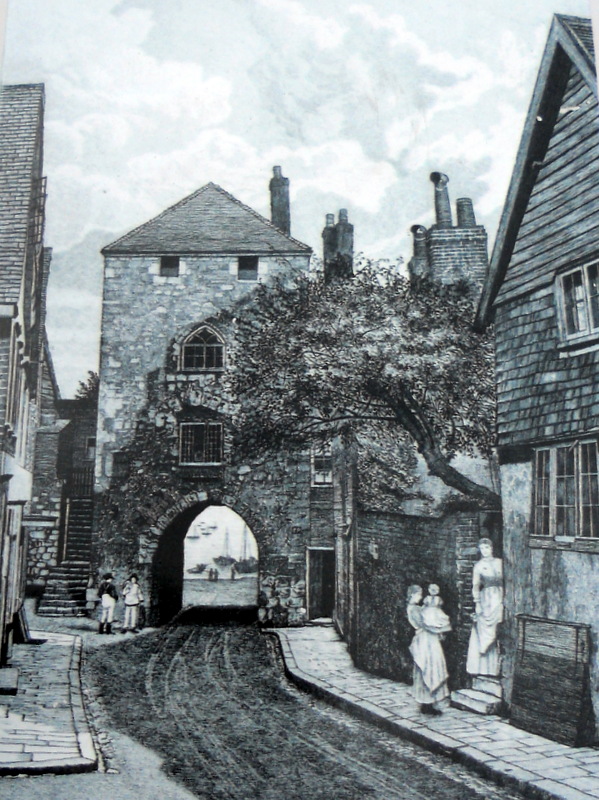
My ancestors lived in Vyse Lane off French Street for over 20 years between 1849 and 1871, and the Lane is still there, but most of it is unrecognisable.

Wellington Hotel and Vyse Lane
The Duke of Wellington pub is still there, but all the cottages have disappeared, maybe well before 1940, because by the 1880s, the area was pitiful, with many houses overcrowded, unhygenic and almost falling down.


Most respectable families had moved Above Bar to the north of the town.  This included my Reed family - my grandmother was one of six daughters of the master baker who had three bakeries and a tea room by the 1890s.

Even John Rose moved a few streets away to Westgate, but still within the old town and nearer to the Town Pier.


He would have felt very comfortable there.  Unlike his sons, most of whom seemed to want to better themselves, John Rose preferred to remain anti-establishment, and seemed far more at home amongst the poor town labourers and in the beer houses.

We also visited the Tudor House Museum in Bugle Street.  This was built during the Tudor times in the 1500s, but has had many uses.  It has been a museum since 1911, but has recently been extensively renovated and brought into the 21st century with a great sound and light show in the banquet room.

Unfortunately the lift to the upper floors stuck, with Paul upstairs, and so we were given our entry fee back.  Almost worth it.  Anyway, they were very good at resolving the problem, and explaining to the staff how the lift worked.

Yes, that's me in the stocks.

And wearing a silly outfit.


Old and the new, with Paul.
Considering the damage, Southampton City Council has done a good job of redesigning the Old Town and minimising the traffic to mostly residents.  New buildings these days must be sympathetic to the remaining buildings.


Monday, June 4, 2012

Diamond Jubilee celebrations at Totton

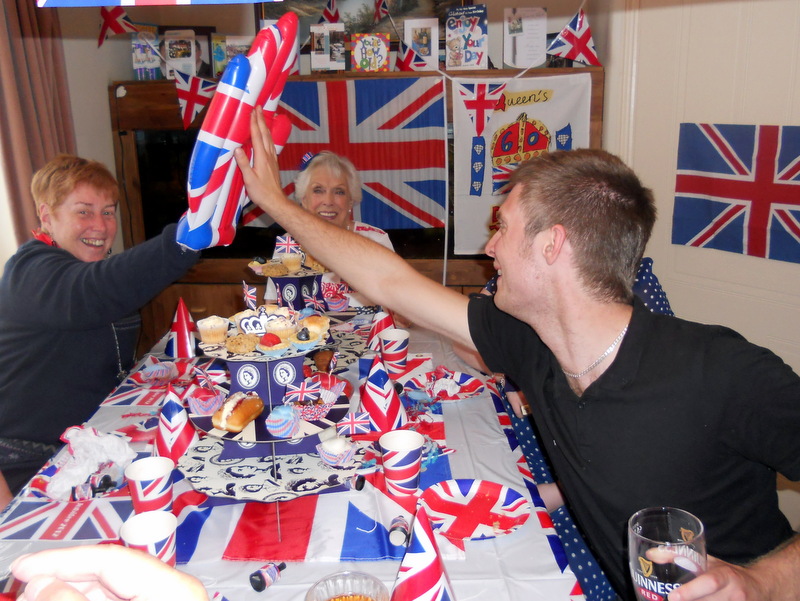
Pity about the weather, but the Poms are used to having lots of it, and it certainly didn't dampen our spirits down here at Totton where Ange and Paul and I started with a huge English breakfast.  Here it is!

This included black pudding, which I did not like, and refused to eat any more of after Ange told me what was in it.... Answer at the bottom of this post.

I couldn't finish my plate, and neither could Paul.  We noted that Ange gave herself a smaller helping but was most insistent we finish ours!
Ange's high tea

Understandably we had no lunch.  The mothers (Paul's mother Bette and Ange's mother Enid) were invited for the high tea which was to follow the watching of the Queen's parade of boats on the Thames.  Here are a couple of photos from the BBC, which I photographed on the TV.

You can see the Queen in white on the barge

Tower Bridge opening


Ange's son Robert and his girlfriend Soozy joined us for the party.

Those English strawberries were simply delicious.

The sandwiches included Coronation Chicken, and salmon and cucumber.

I did the Royal wave and high-fived Robert.

That's Bette at the end of the table.  She was born in the same year as the queen.

We had a great day, as you can see in this photo.

Later, Ange's older son Christopher, a train driver and his wife Sarah, a photographer came over for coffee and cake.


Answer: Oats and pig's blood.

Sunday, June 3, 2012

Isle of Wight with John and Sue Moxon

At Osbourne House
Since John and I (officially me) are taking over Moxon Down Under for The Moxon Society at the end of this year (from Margaret Moxon of Brisbane, no relation), I thought it would be a good idea to make contact with John and Sue Moxon who live on the Isle of Wight.  They are very active in The Moxon Society, and have been since day one, about 25 years ago.  In fact, they met through the Moxon Society, which I find rather sweet.

Before I left Sydney, they had invited me to stay overnight, so me being not so shy these days took up the invitation.  And I'm so glad I did.  They are perfect hosts, and made me feel quite at home, and generously showed me around.

I was able to book the Red Funnel Ferry return trip from Southampton to Cowes online, and a entry ticket to Osbourne House, which is the place Queen Victoria lived and died in 1901.  Her children were mostly brought up there, and it was her favourite place.

Royal wheelbarrows, each with the child's initial
The house of course is huge and her many children had their own cottage about 500 metres away - called Swiss Cottage.  The royal children would have loved it - each child had his or her own garden plot, and Prince Albert would pay them for their produce if it was any good.

Prince Albert encouraged the children to explore and bring back curiosities or strange looking or shaped items.  The Swiss Cottage is full of items from all over the world.

Later Princess Bea, the youngest daughter who looked after Queen Victoria in her old age  lived at Carisbrooke Castle and started a museum there.  Apparently she used to fossick all over the island for articles for the museum - she must have picked up the habit in childhood.

We spent some considerable time at Osbourne House and saw many splendid rooms.  I was most interested in the rooms used during World War 1 as a convalescent hospital.  I was told my grandfather was convalescing there in 1918, but he wasn't an officer, so maybe that story was wrong!  I shall have to check.

After a very pleasant dinner at John and Sue's place we took the dog Nutmeg for a walk down to Northwood House near the water.  It was still light at 8.30pm.

Northwood House built in 1839
Sue is a qualified family history researcher, both John and Sue having done a course with the Heraldic Society.  But John didn't sit the exams.  They are both extremely knowledgeable.


After coming home with a satisfied dog, we sat over a cup of coffee and John filled me in on the history of The Moxon Society.  Very interesting and useful if I am to become more involved at the end of the year.

Then to bed and to catch up with the Sydney Morning Herald on iPad.

The following morning, after a leisurely breakfast we attempted to Skype John (my John Moxon) but not terribly successfully.  We were doing it on their computer since my laptop wasn't on line.  The call kept dropping out.  But nevertheless, Skype is wonderful for keeping in touch.  We are missing each other dreadfully.  Think I'll invest in a magic carpet so I can whisk him over here without going anywhere near Qantas or Heathrow Airport.

A visit to Carisbrooke castle beckoned.  I also had a ticket to that, bought online with a one third concession.  Luckily my hosts have a season ticket to all these heritage listed places, since they often take visitors there.

Carisbrooke Castle was built about 1100 as the main first line of defence for Britain against the marauding French and Spaniards over the centuries.  It is famous for being Charles 1's place of imprisonment in 1647 prior to having his head chopped off in 1648.  He tried to escaped twice but got his shoulders stuck in the window grills.

Replica of bed he slept in - the very room


Just to make me feel at home, here is a reminder of Australia - right outside their house at West Cowes - they have other Australian visitors from time to time.

The lovely Ange met me at the ferry and so to "home" in Totton, near Southampton.

So to bed, and tomorrow will be full of Union Jacks and a very British menu.  I'm no monarchist, but I do appreciate a woman who has done her duty very well for over 60 years - and even before she was Queen she stayed in London throughout the Blitz and drove an ambulance.  Jolly good show!

Wednesday in Eling, Hampshire

Originally I had intended spending the day in Winchester, where the Hampshire Records Office is located, but I decided to take the morning off, since I was feeling totally washed out.  I think Ange was quite disappointed because we were planning to all go.  But Paul was quite pleased, since he had "plenty to do at home".

What I didn't realise was that I was just about to get a virus, so whilst I was tired from all the travelling, in less than a day, I was feeling quite ill with a 24 hour (thankfully) virus.

After lunch however, we visited Eling which is an unspoilt village not more than two miles away on the River Test on the edge of the New Forest.   The water is very brackish since it is at the end of the Solent (Southampton Water) which is tidal.  The water is so clean that its water is used to clean British bank notes.

Eling church of St Mary the Virgin
My Henbest ancestors (William Tucker married Christian Henbest of Bramshaw in 1724) lived in Eling in the 1500 and 1600s.  The main industry was flour milling.  There has been a mill on the site for 900 years, and with a short break, it is still working today.

There are many beautiful walks around the village and its environs.  Here is Ange walking through the graveyard.

To cross the estuary, non-locals have to pay a one pound toll.  However, since we had Paul with his disabled sticker in the car, we did not need to.

The photo shows a local and his dog who had been talking to the toll collector.  The latter was camera shy.

We walked through the village to a couple of nice pubs but they were shut.

Here are Paul and Ange outside one of the pubs.   Like John, Paul can get around so much more easily now that he has a power wheelchair.

The village is very pretty.

So much different from Totton, its near neighbour.  The latter used to be an even smaller village than Eling, but has boomed to become quite a big town.  It is a commuter suburb of Southampton, even though it is outside the boundaries of the city council and is in the New Forest administrative area.